Published by:
CGP EDU Academic Team
Published on: September 12, 2026
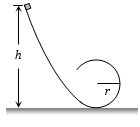
A block follows the path as shown in the figure from height h . If radius of circular path is r , then relation that holds good to complete full circle is
Text Solution
Verified by ExpertsThe correct answer is:
C
To determine the condition required for a block to complete a full circular path, we can use conservation of mechanical energy and the centripetal force requirement.
Step 1: As the block descends from height h, it converts gravitational potential energy into kinetic energy. The potential energy at height h is given by: $$ PE = mgh $$ where m is the mass, g is the acceleration due to gravity, and h is the height.
Step 2: At the bottom of the circular path, this potential energy is converted into kinetic energy. The kinetic energy (KE) is given by: $$ KE = \frac{1}{2} mv^2 $$
By conservation of energy, we have: $$ mgh = \frac{1}{2} mv^2 $$
Canceling m gives us: $$ gh = \frac{1}{2} v^2 \implies v^2 = 2gh $$
Step 3: As the block moves in a circular path of radius r, it requires a centripetal force. The necessary centripetal acceleration is given by: $$ a_c = \frac{v^2}{r} $$
Substituting our expression for velocity gives: $$ a_c = \frac{2gh}{r} $$
Step 4: For the block to maintain its circular path, the gravitational force must provide the required centripetal force at the top of the circle. At the top of the path, the gravitational force is mg, and the required centripetal force is: $$ F_c = m \cdot a_c = m\frac{2gh}{r} $$
The condition for completing a full circle is that the gravitational force at least equals the required centripetal force: $$ mg \geq m\frac{2gh}{r} $$ \implies g \geq \frac{2gh}{r} \implies h \geq \frac{r}{2}
Conclusion: Hence, the relation that holds good to complete a full circle is:
$$ h > \frac{r}{2}
Therefore, option C is correct.
Step 1: As the block descends from height h, it converts gravitational potential energy into kinetic energy. The potential energy at height h is given by: $$ PE = mgh $$ where m is the mass, g is the acceleration due to gravity, and h is the height.
Step 2: At the bottom of the circular path, this potential energy is converted into kinetic energy. The kinetic energy (KE) is given by: $$ KE = \frac{1}{2} mv^2 $$
By conservation of energy, we have: $$ mgh = \frac{1}{2} mv^2 $$
Canceling m gives us: $$ gh = \frac{1}{2} v^2 \implies v^2 = 2gh $$
Step 3: As the block moves in a circular path of radius r, it requires a centripetal force. The necessary centripetal acceleration is given by: $$ a_c = \frac{v^2}{r} $$
Substituting our expression for velocity gives: $$ a_c = \frac{2gh}{r} $$
Step 4: For the block to maintain its circular path, the gravitational force must provide the required centripetal force at the top of the circle. At the top of the path, the gravitational force is mg, and the required centripetal force is: $$ F_c = m \cdot a_c = m\frac{2gh}{r} $$
The condition for completing a full circle is that the gravitational force at least equals the required centripetal force: $$ mg \geq m\frac{2gh}{r} $$ \implies g \geq \frac{2gh}{r} \implies h \geq \frac{r}{2}
Conclusion: Hence, the relation that holds good to complete a full circle is:
$$ h > \frac{r}{2}
Therefore, option C is correct.
Prepare Smarter with CGP Edu
Get practice questions, solutions, and test series in one place.
Write a Review
Share your experience with this question and solution.
Commentary
Send your comment, doubt, correction, or feedback to admin.
Similar Questions
Explore conceptually related problems
In a circus stuntman rides a motorbike in a circular track of radius R in the vertical plane. The m…
A block of mass m at the end of a string is whirled round in a vertical circle of radius R. The cri…
A sphere is suspended by a thread of length l. What minimum horizontal velocity has to be imparted …
A bottle of soda water is grasped by the neck and swing briskly in a vertical circle. Near which po…
A bucket tied at the end of a 1.6 m long string is whirled in a vertical circle with constant speed…
A wheel is subjected to uniform angular acceleration about its axis. Initially its angular velocity…